

Last updated:
Table of contents
- Frequently asked questions about hair thickening and hair transplantation for men in Vienna
- When is hair thickening or hair transplant used in men?
- As a man, what do I have to consider before a hair thickening or hair transplant?
- How does hair thickening work for men?
- How does a hair transplant work for men?
- What risks and complications are possible?
- What do I need to consider after the procedure as a man?
- When are the results visible?
Frequently asked questions about hair thickening and hair transplantation for men in Vienna
When is hair thickening or hair transplant used in men?
Hair thickening or hair transplant is used for people who suffer from thinning hair or severe hair loss. This is a loss of more than 100 hairs per day. A certain amount of hair loss is normal and should be differentiated from pathological hair loss, also known as effluvium.
Both men and women can be affected by hair loss and wish for a thickening of the scalp hair. This is most common with the so-called androgenetic effluvium, which can occur in almost 70 percent of all men and up to 50 percent of women in old age. The reason for this are the androgens, i.e. male sex hormones. But hereditary predisposition, which makes the hair follicles more sensitive to these same hormones, also plays a role in androgenetic hair loss. Early androgenetic hair loss in particular can be effectively treated with hair transplants or hair thickening. In addition to this form of hair loss, there are others that are associated with autoimmune diseases or deficiency symptoms, among other things. Hair thickening or hair transplants are usually not useful.
As a man, what do I have to consider before a hair thickening or hair transplant?
Before hair thickening or transplantation, Dr. Matiasek will hold a detailed consultation with you. He will go into detail about your wishes and ideas and discuss with you the best option for your individual hair situation. Depending on the pattern of hair loss, age and the patient’s wishes, either a hair transplant or hair thickening using the PRP method is recommended.
One week before a hair transplant, it is important to refrain from alcohol and nicotine and, if necessary, from blood-thinning medication. You should also know that the hair at the point of removal has to be shaved and that this will result in bald spots on the back of the head, which, however, will not be visible for long after the hair transplant. Before hair thickening with PRP, it may also be necessary to discontinue blood-thinning or pain-relieving medication, as these impair the function of the blood platelets. You will be informed in advance about all the necessary precautionary measures and what you should consider in your individual case.
How does hair thickening work for men?
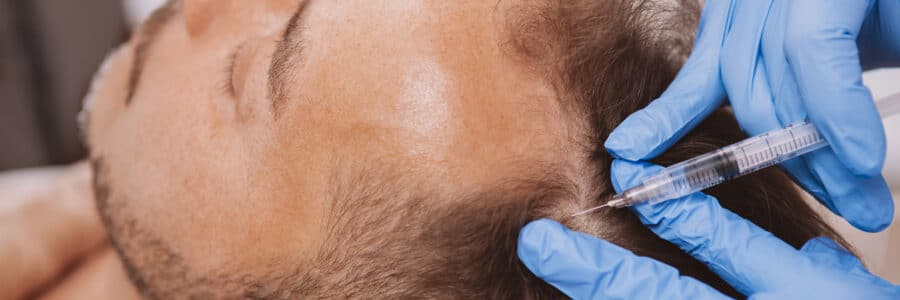
Hair thickening using the PRP method is based on the principle that hair needs sufficient nutrients for healthy growth. To ensure this, patients are injected with a component of their own blood: platelet-rich plasma (PRP). The platelets, also called thrombocytes, contain growth factors that stimulate hair growth when injected directly into the scalp.
To obtain this blood component, a small amount of blood is first taken from a vein in your arm. A special device called a centrifuge then separates the blood into its components, creating the PRP. This is then injected into the scalp with a very fine needle. The entire treatment usually takes between 30 and 45 minutes and is usually not painful because the needles used are particularly thin.
The best results are achieved with PRP hair thickening when hair loss begins. For advanced hair loss, Dr. Matiasesk rather to a hair transplant, whereby the two procedures can also be combined and thus achieve very good results.
How does a hair transplant work for men?
Hair transplantation can be performed using two different methods. One is the FUT method, in which a strip of skin is removed from the back of the head and the necessary hair follicles are extracted from it. In the FUE method, on the other hand, the donor hairs are individually extracted using a fine cannula and implanted into the area to be treated. A further development of the FUE method is the DHI method, in which the donor hairs are implanted using a special instrument instead of tweezers. All hair transplants can normally be performed under local anesthesia. Only rarely is sedation or general anesthesia necessary. Because the scalp is numbed, patients usually do not experience any pain during the procedure.
If the hair transplant takes place using the FUT method, Dr. Matiasek first looks for a good donor site on the fringe of hair or the back of the head. He then removes the donor strip and sews up the resulting wound edges. Using special instruments, Dr. Matiasek removes the hair roots, removes them from the donor strips and stores them in a nutrient solution to protect them from drying out. Small openings are now made in the scalp in the recipient region, into which the hair roots are then inserted.
The main difference to the FUE method is the type of extraction. Because the hair roots are taken directly from the hair ring or the back of the head with a small hollow needle. Planting the roots is done in the same way as in the FUT method.
What risks and complications are possible?
Complications from hair thickening are extremely rare because the injected blood is your own. Rarely, however, redness, swelling or bruising can occur, which will disappear by themselves after a few days. During hair transplantation, swelling and pain at the donor sites can occur, especially during the night after the procedure. Pain and swelling in the forehead and eye area can also occur, but will also disappear on their own after a few days. With the FUT method, visible scarring can occur in the area where the donor strip is removed, which does not happen with the FUE method due to the gentler hair extraction. In rare cases, the transplant does not grow satisfactorily, which can happen especially after infections.
What do I need to consider after the procedure as a man?
After hair thickening with the PRP method, you should cool the affected areas to prevent swelling and pain. In addition, sun protection by wearing a hat is essential in the first week after PRP treatment. A second session is planned after about four to six months. Depending on the response of the person concerned, the PRP treatment can be repeated up to six times.
After a hair transplant, it's important to note that the treated skin will be severely irritated, so normal hair washing is prohibited for approximately two weeks. Four days after the procedure, however, patients can gently cleanse their scalp with a special lotion and a spray bottle. If sutures were used after the FUT method, these should be removed after about one to two weeks. Regular follow-up examinations are conducted to monitor the success of the treatment and discuss the healing progress.
When are the results visible?
Both hair thickening and hair transplantation do not produce instant results. Since the hair thickening by PRP first brings the hair roots into an active growth phase, you have to be patient. Denser hair growth is therefore only noticeable after about three to six months. During hair transplantation, the hair follicles go into a resting phase immediately after the procedure, which is only lifted after about four months. The full result can be assessed after eight to twelve months.
If you are interested in hair thickening or hair transplantation or would like more information about these treatments, Dr. Matiasek would be happy to invite you to his practice for a consultation.
If you are interested in hair thickening or hair transplantation or if you would like further information about these treatments, Dr. Matiasek would be happy to invite you to his practice for a consultation.